
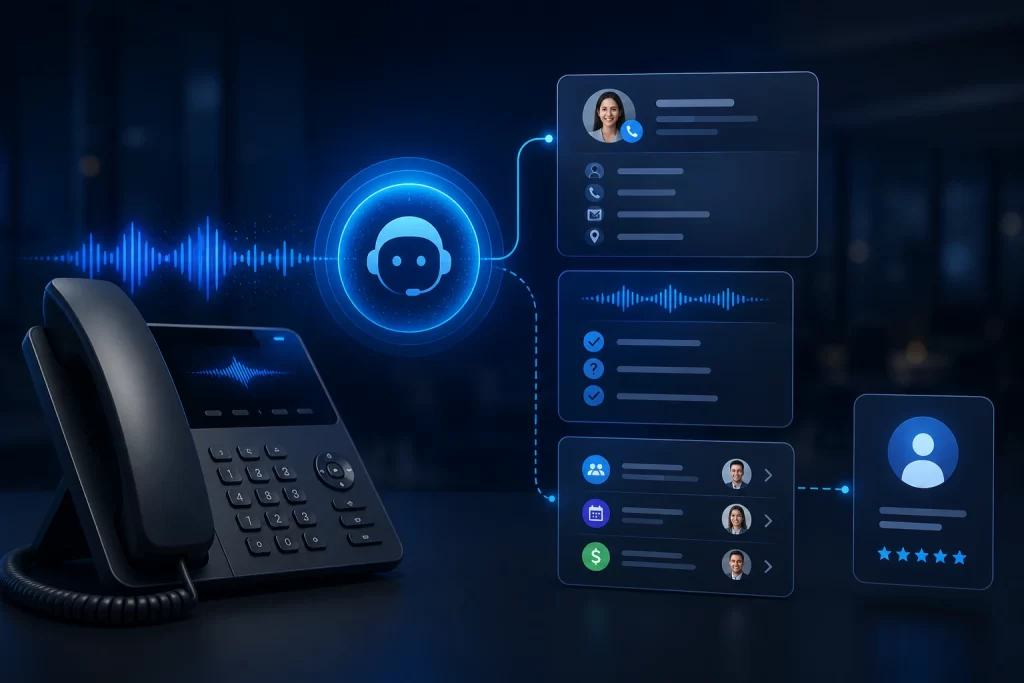
An AI receptionist should not simply be treated as a digital replacement for a traditional receptionist.
The more useful question is:
Which parts of the customer communication process should be automated, and which should remain human?
That distinction can make a major difference in how useful an AI receptionist becomes.
Start With the First Conversation
Many businesses receive inquiries when employees are busy, unavailable or focused on another customer.
An AI receptionist can potentially provide a first layer of response by handling approved questions and collecting useful information.
Depending on the configuration, that information may include:
- Customer name
- Contact information
- Reason for calling
- Service requested
- Preferred appointment time
- Basic project information
- Urgency or other relevant details
The exact workflow should be designed around the business.
Give the AI Clear Boundaries
An AI receptionist should not be expected to invent answers.
Before deployment, the business should define what the system knows and what it is allowed to say.
That can include:
- Services offered
- Business hours
- Service areas
- Frequently asked questions
- Appointment rules
- Contact procedures
- Approved policies
- Escalation instructions
When information is unavailable or a situation requires judgment, the system should have a clear human handoff.
Appointment Requests Need Real Rules
Scheduling is another area where careful configuration matters.
An AI system can collect appointment preferences, but confirmed scheduling should depend on the actual calendar or scheduling system connected to the workflow.
The system should also understand what types of appointments it is allowed to request or confirm.
That prevents the automation from promising something the business cannot actually provide.
AI Does Not Have to Replace Your Team
For many businesses, an AI receptionist can be designed as an additional layer rather than a replacement.
It can support the team during:
- Busy periods
- After-hours inquiries
- High call volume
- Routine questions
- Initial lead qualification
Human employees can remain responsible for complex situations, sensitive conversations, exceptions and decisions requiring professional judgment.
The Better Question
Instead of asking:
“Can AI answer our phone?”
Ask:
“What should happen from the moment a customer contacts us until a team member takes ownership of the opportunity?”
That question produces a much better system design.
DigitalLinks approaches AI receptionist projects around that complete journey—response, information capture, qualification, scheduling where appropriate, notification and human follow-up.
The objective is not simply to make a phone call sound automated.
It is to create a clearer customer-handling process.
Final Thought
A good AI receptionist should know what to do, what not to do and when to involve a person.
Those three decisions are more important than simply adding an AI voice to a phone number.